
Stucco Repair in Cocoa Beach, FL
Rust weeping out from under a window head. A crack on the ocean side that opens a little wider every summer. A patch of wall that sounds hollow when you knock on it. That is what a barrier island does to stucco, and Cocoa Beach is inside our service area. Tony Milam Jr. drives out from Melbourne himself, looks the wall over with you, and says plainly whether it is a patch, one elevation, or more. The written estimate costs nothing. Call (321) 750-5505 and tell him what you are looking at.
An island town, water on both sides
Cocoa Beach is not near the water. It is in it. The city sits on a barrier island with 5.6 miles of Atlantic oceanfront along its east edge and the Banana River along its west, and of the roughly 15 square miles inside the city limits, fewer than 5 are land. State Road A1A runs the length of town as a three-mile one-way pair — Atlantic Avenue northbound, Orlando Avenue southbound — rejoining north of 4th Street. Nearly every house sits a few hundred yards off one shoreline or the other. There is no sheltered inland half of town.
The houses are older than most of Brevard's, too. There were 246 people living here in 1950; the space program came, and the count hit 3,475 by 1960 and 9,952 by 1970. Around 37% of the housing stock in Cocoa Beach went up between 1940 and 1969, another 54% between 1970 and 1999, and under 8% of it since 2000. Run that math on a wall and you get fifty or sixty years of salt, sun and sideways rain on one finish, plus every coat of paint and quick fix applied since.
What the ocean gets to first
- Brown rust bleeding from lintels, window heads and stucco stops, worst on whichever wall faces the Atlantic
- Hollow, drummy stucco where water has been getting behind the coat for years
- Cracks at window and door corners that reopen after every hard blow off the water
- Paint blistering and peeling off a wall that got sealed while it still held moisture
- A chalky, sanded-down finish on the ocean side while the west wall of the same house still looks close to new
- Bare or roughly filled block around a carport enclosure, garage conversion or added room from an earlier owner
Why an oceanfront wall is not a routine patch
The most common mistake on a salt-coast house is sealing over rust. Corroded steel keeps swelling under a fresh patch and pushes it right back off, so embedded metal gets cleaned back and treated before new material touches it. We open the wall far enough to find where water is actually entering — a bad joint, a flashing detail, a crack somebody caulked instead of fixing — then rebuild in coats so the repair bonds to what is already there instead of sitting on top of it. Texture gets matched by hand against your wall before we commit. On a low beach house with long flat elevations, a patch in the wrong texture is visible from the road for good.
Recent work across Brevard County
Same crew, same trowel, every job on this coast. Each one shows the city it was done in.
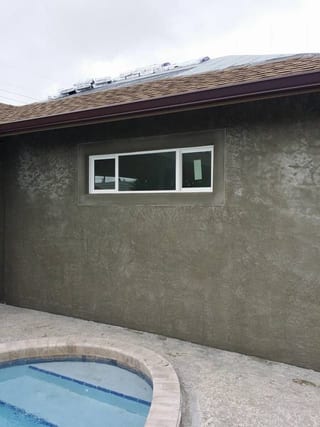
Palm Bay
Full-home re-stucco in Palm Bay
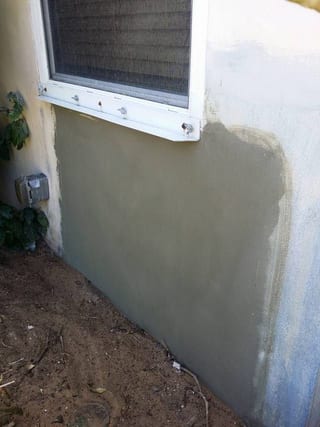
Satellite Beach
Cracking & water damage repair in Satellite Beach
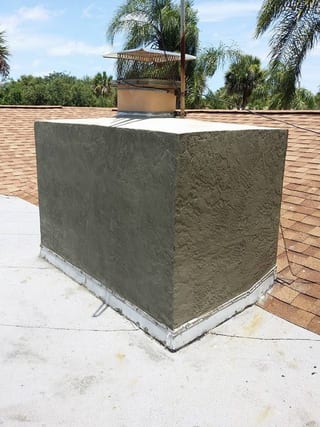
Viera
Bulging stucco repair in Viera
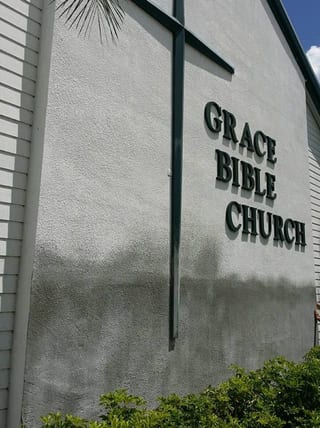
Indialantic
Finish match after another contractor's patch in Indialantic
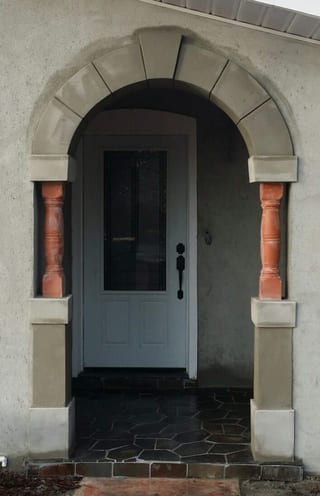
Melbourne
Brick entry refinished in stucco in Melbourne
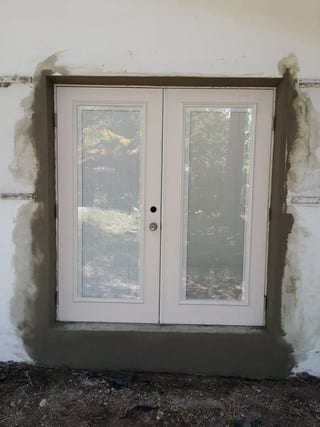
Cocoa
New french doors stuccoed in on a Cocoa home


Get a range before anyone knocks on your door
Take a few photos on your phone — the crack, the rust run, the spot that sounds hollow — and run them through the estimate form on this site. The AI reads the photos and hands back a rough price range in about a minute, which is enough to start thinking about a budget. Tony's visit and his written estimate are free either way, and his number is the one that counts.
Cocoa Beach stucco questions
- Does being right on the ocean really make stucco fail faster?
- Mostly it goes after the steel inside the wall. Salt in the air is heaviest near the surf and thins out inland, but there is no clean mileage rule — two houses the same distance from the water can weather very differently depending on which way each one faces.
- The ocean side of my 1960s house looks far worse than the rest. Do I have to redo the whole house?
- Usually not. We sound each wall and find out how much is still bonded. If one elevation has let go and the others are sound, we rebuild that face and match it in. Doing a whole house at once only makes sense when the failure is everywhere, not on one exposed side.
- Should I wait until hurricane season is over to have it repaired?
- An open crack takes on wind-driven rain all season, and the damage behind it keeps going between storms, not only during them. If the wall is already cracked, sooner is better. We still come out in the fall, and the look costs you nothing either way.
What Brevard homeowners say
5.0 from 7Google reviews

Ron Mcgaha

Joyce Dree

Chris Nowlan
Have someone look at your Cocoa Beach wall
You get Tony on the phone, and Tony in the driveway — no call center, no commission salesman, no crew you have never met. One number: (321) 750-5505.