
Stucco Repair in Melbourne, FL
Melbourne is home — it is the address on our own paperwork, not a pin we dropped on a service map. So when a wall opens up on New Haven, off Babcock, or over in Eau Gallie, the drive is measured in minutes. Tony Milam Jr. does the walk-around himself, says plainly what the wall needs and what it does not, and leaves a written estimate that costs nothing. Call (321) 750-5505.
Three eras of building, one city
Melbourne is older than almost everything around it. The village incorporated in December 1888, and for the next eighty years Eau Gallie sat immediately north as a separate town with its own downtown and its own boat basin — the two did not become one city until the 1969 merger. Drive New Haven Avenue and then drive Highland Avenue and you are looking at two different towns that agreed to share a name.
That history is written into the walls. The oldest cores were not built the way the rest of Brevard was: original stucco here can sit on hollow clay tile, or on wood frame over wire lath, not the concrete block everyone assumes. Then came the boom after the Cape — thousands of engineering families arriving through the fifties and sixties, and street after street of block ranch homes thrown up quickly with a thin original coat. North of the Eau Gallie Causeway the build-out kept going for decades more.
And all of it sits beside the Indian River. Salt carries inland on the wind here in a way it simply does not eight miles west, and it goes after the steel first — lintels, stucco stops, anything embedded. That is why a Melbourne wall so often fails as a rust stain long before it fails as a crack.
What actually brings us out here
- Brown rust weeping down from a lintel or a window head, worst on the river side of the house
- Stucco spalling off in sheets where corroding steel has expanded behind it
- Hollow, drummy patches on pre-war walls where the coat has let go of clay tile
- Old repairs on historic-core homes done in a material that never belonged there
- Thin fifties-era coats on block ranches worn through to the wall behind
- Settlement cracking on the newer streets north of the causeway
- Raw block on a lanai, a garage conversion, or an addition nobody ever finished
Finding out what is behind it first
The first job on an older Melbourne house is establishing what we are even repairing — block, tile and lathed frame all fail differently and none of them take the same fix. We sound the wall out, open it where the sound goes hollow, and deal with whatever caused the failure before a single coat goes back on. Rusted steel gets treated, not buried; buried steel keeps swelling and the repair pops in a season. Only then does the wall get rebuilt in layers so the new work grips instead of riding on top. Texture is matched by hand against the existing finish and mocked up before we commit, because on a street where the houses are near-identical a mismatched patch is the only thing anybody sees.
Melbourne jobs, start to finish
Our own photographs of our own work, in this city. Open any project to see the whole set.
See the whole gallery
Recent work across Brevard County
Same crew, same trowel, every job on this coast. Each one shows the city it was done in.
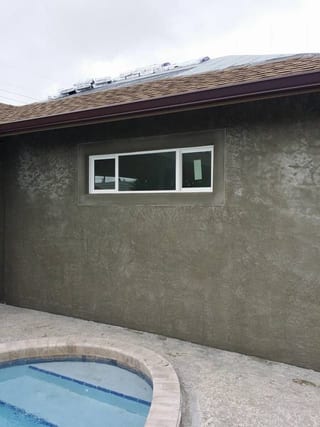
Palm Bay
Full-home re-stucco in Palm Bay
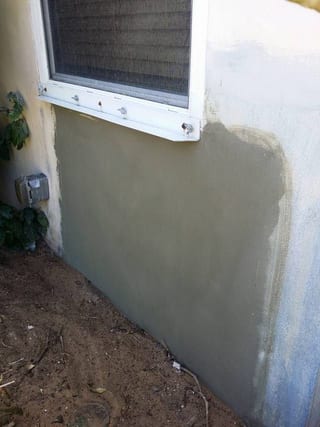
Satellite Beach
Cracking & water damage repair in Satellite Beach
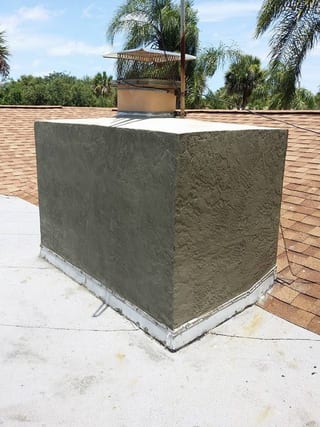
Viera
Bulging stucco repair in Viera

Indialantic
Finish match after another contractor's patch in Indialantic
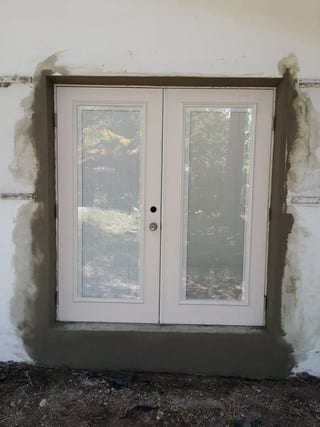
Cocoa
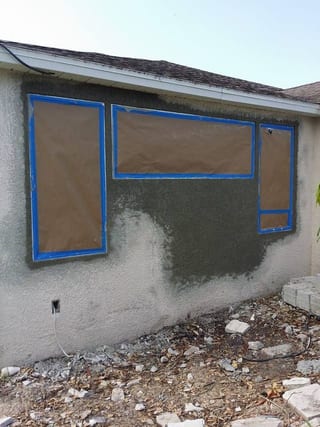
New french doors stuccoed in on a Cocoa home
Rockledge
New lakeside windows stuccoed in on a Rockledge home


Know the number before anyone comes out
Photograph the damage on your phone, attach the pictures to the estimate form, and our AI reads them and returns a ballpark range in roughly a minute. It is a starting point, not a quote. The real number comes from Tony standing in front of the wall, and that visit costs nothing whether you use the form or not.
Questions we get from Melbourne homeowners
- My house is from the 1920s and is not concrete block. Can you still work on it?
- Yes, and it matters that you asked. Plenty of stucco in the historic core sits on hollow clay tile or on wood frame over wire lath, and each one wants a different repair. Guessing wrong is how a patch ends up drumming a year later. We identify the substrate before quoting rather than assuming block.
- Why does the rust staining keep coming back after we paint over it?
- Because paint hides the symptom while the cause keeps growing. Salt air off the Indian River corrodes embedded steel, corroded steel expands, and the expansion pushes the stucco off. Until that steel is exposed and treated, every coat of paint is a countdown. This is the single most common repeat problem we see on the river side of town.
- We were told the whole house needs re-stuccoing. Is that usually true?
- Sometimes, and we have done exactly that job here — it is in the gallery. But often it is not, and a wall that needs three panels rebuilt does not need eleven. You will get told which one it is, with the reasoning, and nothing is sold to you on the spot.
What Brevard homeowners say
5.0 from 7Google reviews

Ron Mcgaha

Joyce Dree

Chris Nowlan
Talk to somebody local about it
No call center, no salesman, no follow-up campaign. The owner answers, and the visit is free. (321) 750-5505.